
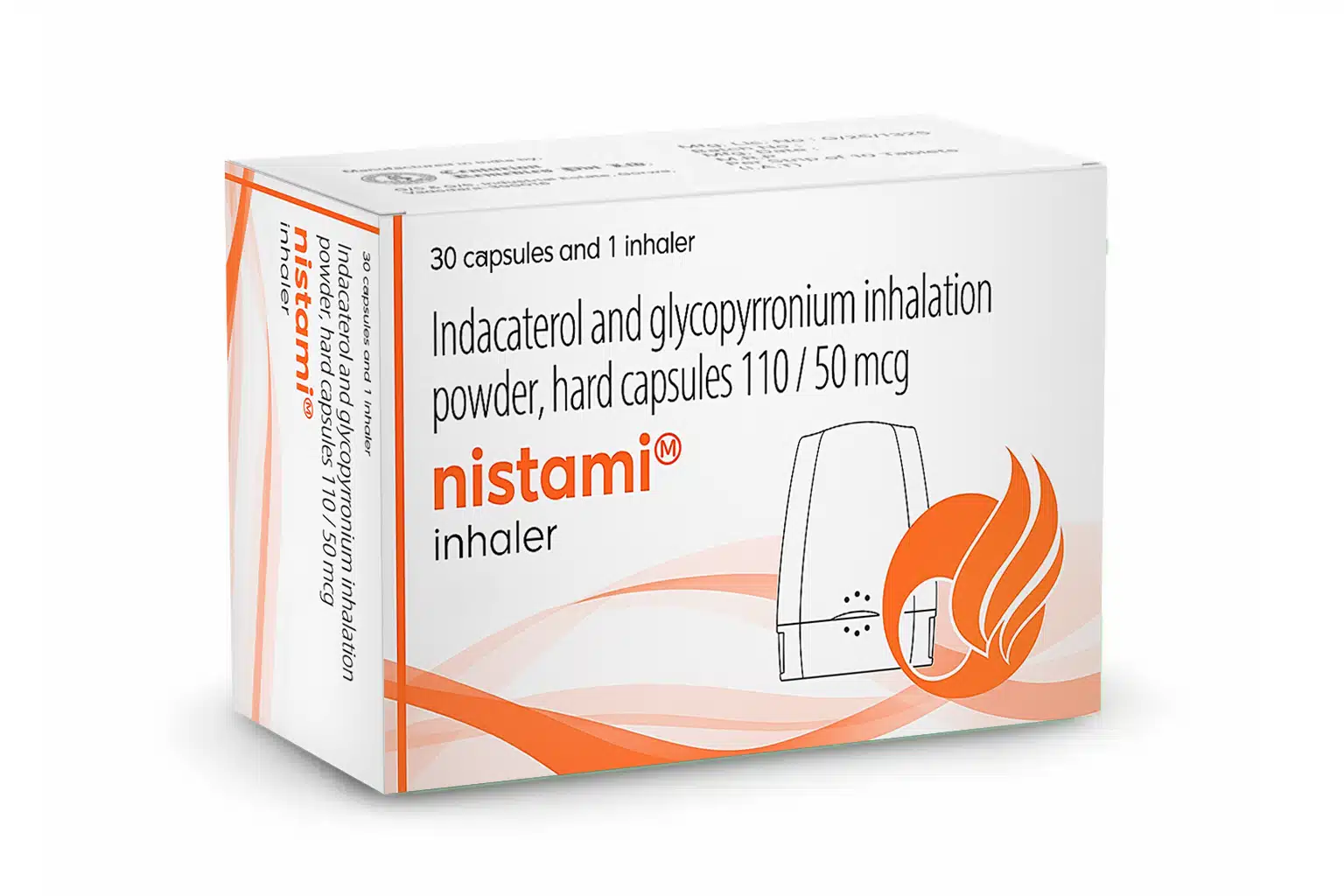
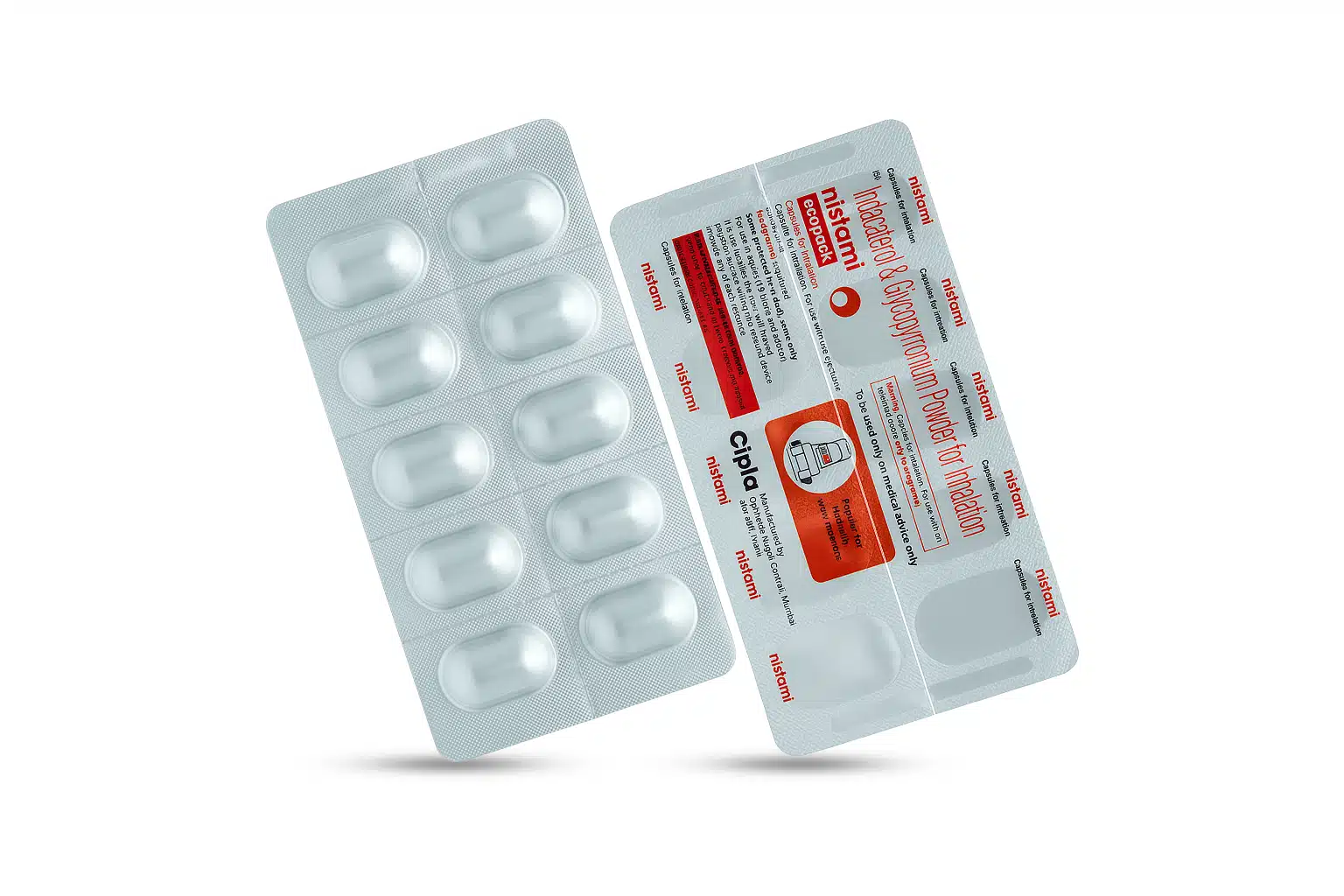
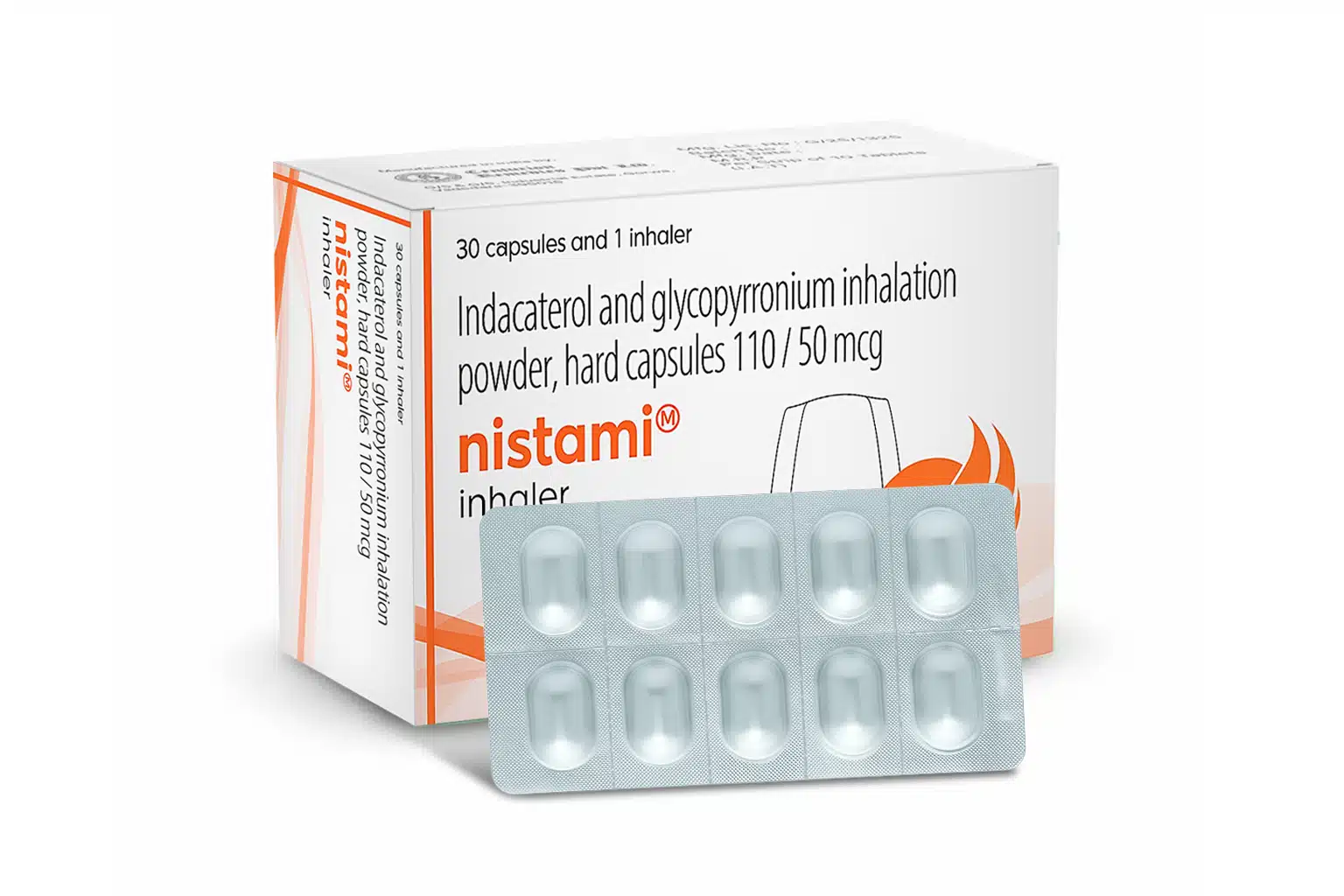
Nistami Inhaler is a once-daily inhaler made to help adults with chronic lung disease breathe better. It mixes two long-acting bronchodilators: indacaterol (a LABA — long-acting beta-2 agonist) and glycopyrronium / glycopyrrolate (a LAMA — long-acting muscarinic antagonist). Together these two medicines open airways and reduce mucus. The result is easier breathing, less wheeze, and fewer flare-ups for people with COPD.
Key Features
| About | |
|---|---|
| Drug Class | Respiratory agent |
| Subclass | Long-acting muscarinic antagonist (LAMA) + long-acting beta2-agonist (LABA) combination |
| Product Details | |
|---|---|
| Composition | Active ingredients:
Inactive ingredients:
|
| Packaging Type | Rotacaps |
| Pack Size | 30 Capsules |
| Dosage | 1 respules (500 mcg) 3-4 times a day |
| Therapeutic class | Bronchodilator for COPD |
| Action Class | Bronchodilator (anticholinergic + beta2-agonist) |
| Chemical class | Indacaterol, Glycopyrronium |
| Manufacturer | Cipla Ltd (India) |
| Shelf Life | 2–3 years from the date of manufacturing |
| Usages | Maintenance treatment of chronic obstructive pulmonary disease (COPD) |
| Country of Origin | India |
| Storage | Store at room temperature (20°C–30°C) in a cool and dry place, protected from direct sunlight, moisture, and heat. |
How Nistami Inhaler works
Indacaterol (LABA): Indacaterol relaxes the small muscles that sit around the airways. When these muscles relax, the airway widens. This helps air move in and out of the lungs for many hours after one dose. Indacaterol works fast and lasts about 24 hours.
Glycopyrronium (LAMA): Glycopyrronium blocks certain nerve signals that tighten airway muscles and cause mucus to build up. Blocking those signals keeps airway muscles relaxed and cuts down on mucus. Glycopyrronium also has a long action that fits once-daily dosing.
Why does the combo work well?
LABA + LAMA pairs act on two different targets. One relaxes muscles via beta-2 receptors. The other blocks muscarinic receptors that cause constriction and secretions. Their effects add up. Dual long-acting bronchodilation often gives better lung opening and symptom control than one drug alone. This is the basis of the Nistami Inhaler formulation.
Uses
Nistami Inhaler is used mainly as a maintenance treatment for Chronic Obstructive Pulmonary Disease (COPD) in adults. That includes chronic bronchitis and emphysema where long-term bronchodilation is needed. It helps reduce breathlessness, coughing, mucus and the need for rescue inhalers. Nistami is not meant for sudden breathing attacks. For an acute flare, use a short-acting rescue inhaler.
Typical dosage and device
The usual form of the product sold in pharmacies is a dry-powder or capsule/inhaler pack that delivers indacaterol 110 mcg + glycopyrronium 50 mcg per dose (check your pack for exact strength). Most labels and clinical trials use once-daily dosing. Always follow your doctor’s exact instructions. Do not change dose or stop suddenly without medical advice.
How to use Nistami Inhaler — step-by-step
- Read the patient leaflet that comes with your inhaler.
- If it is a capsule + device type: load the capsule exactly as shown. If it is a prefilled device, open the mouthpiece.
- Breathe out fully away from the device.
- Place the mouthpiece in your mouth and seal with your lips.
- Take a quick, deep breath in while you activate the inhaler (or as instructed).
- Hold your breath for 5–10 seconds. Then breathe out slowly.
- Rinse your mouth if your inhaler contains any steroid (Nistami usually does not include steroid; still rinsing is good practice when told).
- Keep the device clean and store it as instructed.
If you are unsure which device you have, ask your pharmacist or doctor for a demonstration.
Pharmacokinetics
When inhaled, most of the drug acts in the lungs where it is needed. A small amount reaches the bloodstream. Indacaterol is absorbed in the lung and gives prolonged bronchodilation with once-daily dosing. Glycopyrronium acts mainly in the airways with low systemic exposure when used by inhalation. Studies comparing pharmacokinetics across populations have shown consistent lung delivery and safety profiles.
Common side effects
Most side effects are mild. Common effects reported with indacaterol and glycopyrronium include:
- Headache.
- Cough (sometimes immediate after inhalation).
- Nasal or throat irritation.
- Dry mouth (more common with anticholinergics like glycopyrronium).
- Dizziness or nausea in some people.
If side effects are severe or long-lasting, speak to your doctor. Clinical trials show these drugs are generally well tolerated in COPD patients.
Serious but uncommon risks and warnings
- Heart effects. LABA medicines can cause fast heartbeat or palpitations in some people. If you have heart disease, tell your doctor.
- Urinary retention, dry eyes, or severe dry mouth. Anticholinergic drugs can worsen these conditions. Be cautious if you have prostate problems or bladder outlet obstruction.
- Allergic reactions. Swelling, rash or sudden breathing trouble are rare but need immediate care.
- Not for acute attacks. Nistami Inhaler is for maintenance. Keep a rescue inhaler for sudden breathlessness.
Always tell your provider about other medicines you take. Beta-blockers, some antidepressants, or other inhaled drugs can affect safety or reduce benefits.
Interactions
- Beta-blockers (used for heart disease or anxiety) may blunt the effect of LABAs.
- Other anticholinergic drugs can add to dry mouth or urinary problems.
- Certain heart drugs or medicines that change heart rhythm may need close monitoring.
Give your doctor a full medicine list, including herbal supplements.
Clinical evidence
Clinical trials and reviews support indacaterol and glycopyrronium as effective maintenance bronchodilators. Indacaterol provides fast onset and 24-hour relief in COPD. Glycopyrronium delivers sustained bronchodilation with a good safety profile. Studies of combined indacaterol + glycopyrronium show improved lung function, reduced symptoms, and fewer days needing rescue medication compared with single agents. These data underlie the use of dual long-acting bronchodilators like the Nistami Inhaler.
Practical points and storage
- Store the inhaler at room temperature. Avoid extreme heat or cold.
- Keep it dry and replace the device if it is damaged.
- Check expiry date before use.
- Carry a rescue inhaler if you are at risk of sudden breathlessness.
- If you miss one dose, take it when you remember. Do not double the next dose.
Precautions in special groups
- Pregnancy and breastfeeding: Limited data exist. Use only if clearly needed and after doctor discussion.
- Older adults: May be more sensitive to side effects such as dry mouth or dizziness.
- Children: Nistami is generally intended for adults with COPD. Check age-specific approvals on the pack and ask your doctor.
Conclusion
Nistami Inhaler is a fixed-dose dual bronchodilator taken once daily. It pairs indacaterol (a long-acting beta-2 agonist) with glycopyrronium (a long-acting muscarinic antagonist). The two medicines work together to widen airways and reduce mucus. This helps many adults with COPD breathe easier and lowers the need for rescue medications. Nistami should only be used as directed and not for sudden attacks. Call your doctor right away if you have heart disease, problems with your urine, or new symptoms after starting the inhaler.
References
https://pmc.ncbi.nlm.nih.gov/articles/PMC3728154/
https://pubmed.ncbi.nlm.nih.gov/23677802/
https://pmc.ncbi.nlm.nih.gov/articles/PMC4410821/
https://dailymed.nlm.nih.gov/dailymed/medguide.cfm?setid=7782a48e-38bb-404a-94ef-051278d8bfef
Sarah Mitchell –
Doctor prescribed this for COPD. It’s working fine, no big complaints